API-First Development Strategy — Why Your Next Software Project Should Start with the API

The sprint demo starts flawlessly: the front-end team ships a polished dashboard with live charts, dark mode, and real-time notifications. Six months later, when the mobile team or a partner needs that same experience, the underlying endpoints turn out to be an inconsistent, undocumented mess of ad-hoc RPC calls and duplicated business logic. Every new surface — mobile app, partner portal, AI-powered feature — now demands a costly rewrite. This is the hidden cost of building back-ends as an afterthought, and it is precisely the problem that API-first development solves. At AEGONTECH, we treat the API as the permanent product contract and the UI as just one of many consumers.
Key Takeaways
- API-first development is a design discipline where the application programming interface is specified and agreed upon before any front-end code or server-side business logic is implemented — it turns your API into the system's single source of truth.
- Teams that adopt API-first practices ship integrations 40–60% faster and experience fewer breaking-change incidents in production, according to the Postman 2024 State of the API Report.
- An OpenAPI or GraphQL schema, when authored first, generates documentation, mocks, type-safe SDKs, and automated contract tests — eliminating the drift between what the documentation promises and what the code actually delivers.
- API-first is not about picking REST over GraphQL; it is about committing to a contract-first discipline that keeps every consumer — front-end, back-end, third-party — aligned from day one.
What Is API-First Development and How Is It Different from Writing Code First?
API-first development is an architectural approach where the application programming interface — the set of rules, protocols, and endpoints that let software components communicate — is designed, documented, and agreed upon before any front-end UI code or server-side business logic is implemented. In a code-first workflow, developers typically build the back-end logic and database layer first, then expose endpoints as an afterthought — often producing inconsistent, undocumented interfaces shaped by implementation details rather than consumer needs.
The distinction matters deeply for system longevity. An API (Application Programming Interface) defines how different software components talk to each other — whether it is a React front-end calling a Node.js service, a mobile app fetching data from a Python back-end, or a third-party partner integrating with your platform. When you design the API contract first, you are making an explicit promise about data shapes, error handling, authentication, and versioning before a single line of implementation code exists. This contract becomes the testable, reviewable artifact that every team — front-end, back-end, DevOps — aligns around.
The most common API design styles today are REST (Representational State Transfer — a resource-oriented style where each endpoint represents a noun like /users or /orders and HTTP verbs define the action) and GraphQL (a query language developed by Facebook that lets clients request exactly the data they need from a single endpoint). Both can be API-first, and both benefit from having their contract — an OpenAPI specification (the industry-standard machine-readable description format for REST APIs, formerly known as Swagger) or a GraphQL schema — authored before implementation begins.
AEGONTECH LLC applies this discipline across every project: from the AI-powered mobile app designer Dolfy.ai to the browser-based international calling platform Dialable.world. In each case, the API contract is the first artifact produced — before a single React component or database migration is written.
What Happens When Teams Skip the API Contract and Build the UI First?
When teams build the front-end or business logic first and retrofit the API afterward, they usually end up with endpoints that mirror internal implementation details rather than consumer needs. The result is often called "accidental API design" — interfaces that are inconsistent, poorly documented, tightly coupled to a specific front-end framework, and impossible for an external partner to consume without a dedicated integration engineer.
The financial and operational costs compound quickly. According to industry data from SmartBear's 2023 State of Software Quality, teams that lack automated API contract testing report up to 62% more defects reaching production than teams that validate their APIs against a formal specification. Each defect translates into hotfixes, degraded user trust, and rework that delays roadmap features. In the code-first world, API documentation — if it exists at all — falls out of sync with the implementation within weeks, and the Swagger UI that looked impressive during the demo becomes a museum of broken examples.
The integration tax is steeper still when you scale. Every new consumer — a mobile team, an AI feature, a partner's system — needs a bespoke integration effort because no shared contract exists. The IEEE Software journal's 2024 industry survey found that organizations practicing API-first design completed integrations an average of 2.3× faster than code-first organizations, largely because the API contract serves as a shared language between all consuming teams.
API design best practices — consistent HTTP status codes, predictable error formats, versioned endpoints, and clear rate-limiting headers — are dramatically easier to enforce when the contract exists before the code. Code-first teams almost always retrofit these concerns, and retrofitting contracts onto a running system is orders of magnitude harder than writing them from scratch.
What Does a Real-World API-First Workflow Look Like?
When AEGONTECH starts a new project — whether it is a SaaS platform, an enterprise integration, or a feature like Dolfy.ai's template engine — the engineering team follows a disciplined, six-step API-first strategy:
1. Model the domain and boundaries. Before any OpenAPI YAML or GraphQL SDL is written, the team identifies the system's bounded contexts: users, orders, billing, analytics, notifications. Each context gets clear ownership and a well-defined interface surface. This ensures the API does not accidentally expose internal data models or cross-domain coupling.
2. Author the API contract. The team produces a complete OpenAPI 3.1 specification or GraphQL SDL (Schema Definition Language — the human-readable language for describing GraphQL types, queries, and mutations). The contract defines every endpoint, request and response schema, authentication scheme, error format, and example payload. At this stage, no implementation code exists — only the contract.
3. Generate documentation, mocks, and SDKs. From the contract, the toolchain produces: an interactive API documentation portal (via tools like Swagger UI or Redoc); a mock server that returns valid example responses so the front-end team can build against realistic data immediately; and type-safe SDK (Software Development Kit — a client library that wraps raw HTTP calls into typed, autocompleted function calls for a specific language like TypeScript or Python) clients using code generators like openapi-generator or graphql-codegen.
4. Write contract tests. The team writes contract testing — automated tests that validate the API server's actual behavior against the contract specification. Unlike end-to-end tests, contract tests are fast, reliable, and run as part of the CI/CD pipeline. They catch breaking changes, missing fields, and type mismatches before they reach staging, let alone production.
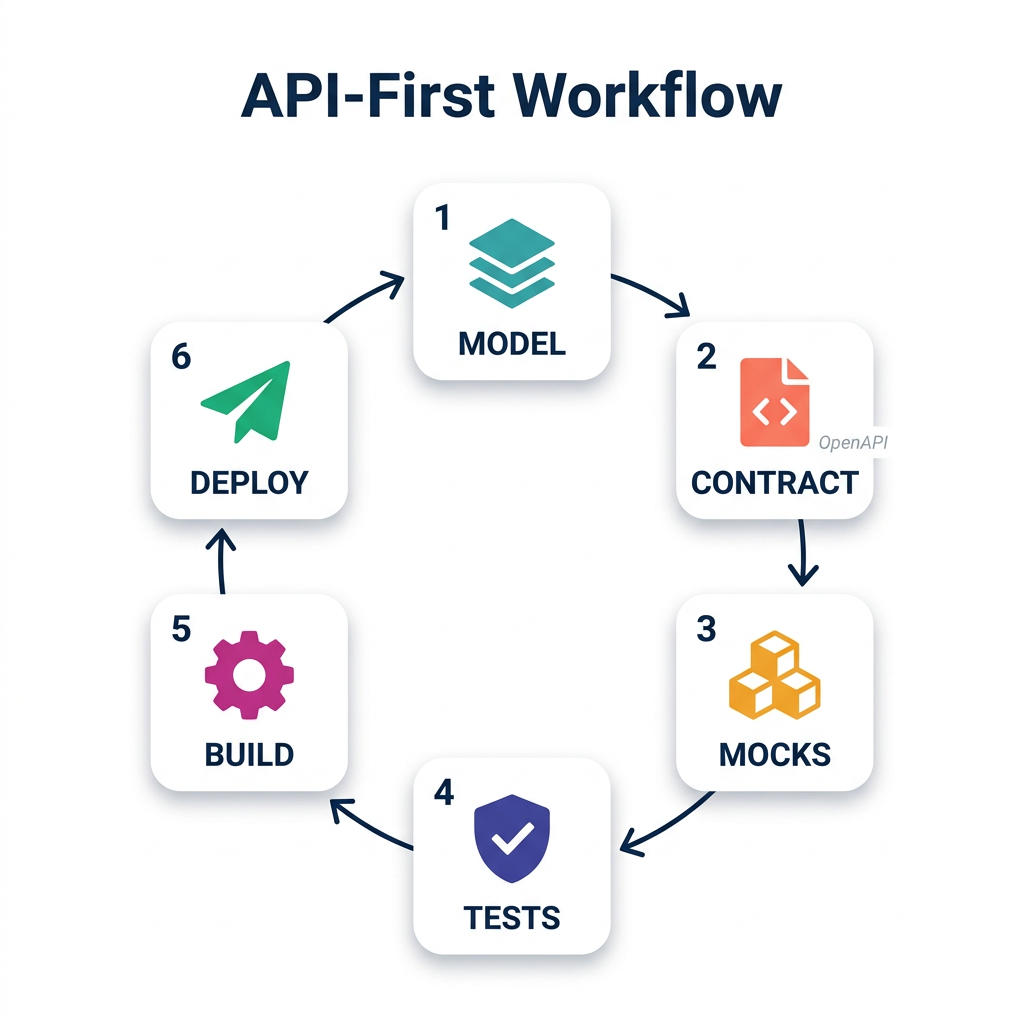
5. Implement the API. With the contract as the test oracle, the back-end team implements the API. Every endpoint passes or fails against the contract, not against a QA engineer's intuition. The front-end team has been developing against the mock server in parallel since step 3 — meaning front-end and back-end work is genuinely parallel, not sequentially blocked.
6. Version deliberately. The team follows semantic versioning for the API — incrementing the major version only when a breaking change is unavoidable, and deprecating old versions with clear communication timelines. No team at AEGONTECH uses URL-path version hacks (/v1, /v2 in the URL) without understanding the operational overhead that creates.
This workflow, powered by technologies like Node.js, Python, React, Next.js, PostgreSQL, MongoDB, Docker, Kubernetes, and AWS, consistently delivers projects where the first external integration takes hours rather than weeks.
How Do You Design APIs That Scale Across Teams and Time?
An API-first strategy is incomplete without production-grade infrastructure that protects the API, manages its lifecycle, and makes it discoverable. Three components deserve particular attention: the API gateway, idempotency, and rate limiting.
An API gateway is a reverse proxy that sits between clients and your back-end services, handling cross-cutting concerns — authentication, rate limiting, request routing, caching, and logging — in a single layer. Products like AWS API Gateway, Kong, and NGINX let you enforce these policies without duplicating code in every microservice. In an API-first architecture, the gateway configuration is generated from the OpenAPI contract, not hand-configured by a DevOps engineer at 2 AM.
Idempotency is the property that a request can be safely retried without creating duplicate side effects — charging a customer twice, for example. API-first designs bake idempotency into the contract from the start through idempotency keys and clear PUT/POST semantics. Rate limiting — capping how many requests a client can make per time window — is defined during contract design, not bolted on after a DDoS incident or a runaway client script drains your database connection pool.
OAuth 2.0 (an industry-standard authorization framework that lets applications obtain limited access to user accounts without exposing credentials) and JWT (JSON Web Token — a compact, self-contained token format used for stateless authentication) should be part of the contract specification. When your OpenAPI spec defines the security schemes upfront, every autogenerated SDK, mock server, and test suite automatically handles authentication — eliminating another source of implementation drift.
Webhooks (user-defined HTTP callbacks that your API fires when an event occurs, like "an order was placed") also belong in the contract. Versioning, too, must be a first-class contract concept, not a last-minute decision. An API published without a versioning and deprecation strategy is an API that will break its consumers silently — and silent breakage is the fastest way to lose developer trust.
An API gateway configured from the contract, combined with contract tests and monitoring, creates what AEGONTECH calls a "defense-in-depth API posture" — one where breaking changes are caught at the test level, rate-limit violations are prevented at the gateway level, and deprecated endpoints are communicated via the developer portal.
FAQ: API-First Development
Q: Is API-first development only for microservices, or does it apply to monoliths too?
API-first development applies to any architecture where multiple consumers need to interact with a system. A well-designed API contract is equally valuable for a monolith exposing a REST interface as it is for a microservices mesh. The contract keeps the monolith's boundaries clean and prevents the codebase from becoming a spaghetti of direct database calls.
Q: How do you handle breaking changes in an API-first strategy?
Breaking changes should be avoided whenever possible — expand contracts with optional fields, never remove or rename required ones within a major version. When a breaking change is truly necessary, increment the API's major version and run the old and new versions in parallel for a documented deprecation window (typically 6–12 months), communicating the timeline through the developer portal and deprecation headers.
Q: Does API-first development mean everything must be designed upfront with no room for iteration?
No. API-first means the contract is specified upfront, but the contract itself evolves iteratively. Adding new endpoints, extending schemas with optional fields, and introducing new resources are all backward-compatible changes. The key discipline is that contract changes go through review before implementation, not after.
Q: Can API-first development work with AI and large language model integrations?
Absolutely. AI features typically consume APIs just like any other client. An API-first posture means that when you decide to expose a summarisation or classification endpoint to an LLM, the contract already governs authentication, rate limiting, input validation, and response formatting — the AI implementation is just another consumer.
The Future of Software Development Is API-First
As software ecosystems become more interconnected — with mobile apps, web apps, partner integrations, and AI agents all consuming the same data — the inconsistency of code-first API design is no longer a minor inconvenience. It is a competitive liability. Organizations that treat their APIs as second-class artifacts will spend an increasing share of their engineering budget on integration tax, while API-first organizations ship new surfaces, partners, and features faster and with fewer production incidents.
The API-first development strategy that AEGONTECH LLC brings to every engagement — from building the next-generation mobile app designer at Dolfy.ai to powering real-time international communications on Dialable.world — is not a luxury for hyperscale companies. It is a practical, repeatable discipline that pays for itself on the very first integration. When the API contract is the product, every consumer benefits, and the engineering team spends its time building features rather than fixing undocumented endpoints.
Explore how AEGONTECH can help your team adopt an API-first development discipline by visiting aegontech.dev — where custom software development starts with a contract, not a codebase.